

The best AI companion app is the one that matches the kind of connection and experience you actually want. Some apps are built around fast character chat. Others focus on roleplay, romance, story, creativity, or a broader virtual world. The useful question is not simply which app can produce the smartest reply. It is whether the characters feel distinct, whether you can find someone you like, and whether the experience gives you a reason to return.
This guide offers seven practical criteria for comparing AI companion apps. It does not assume that one product is right for everyone. Instead, it helps you look beyond a polished first message and evaluate the full experience around discovery, identity, context, conversation, continuity, and boundaries.
Pogee's approach is built around living AI characters with profiles, daily moments, stories, discovery, and chat. That makes it a useful example of a companion app designed as a character world rather than only a message box.
1. Decide What Kind of Companion Experience You Want
Before comparing features, define the experience you are looking for. "AI companion" can describe several very different products.
You may want:
- Casual conversation with a consistent personality
- Romantic or emotionally warm character interaction
- Fantasy, school-life, or slice-of-life scenarios
- Creative roleplay and collaborative storytelling
- A world of characters to browse and discover
- A familiar virtual presence you can revisit without pressure
These goals overlap, but they are not identical. A chat-first app may be enough for quick roleplay. A story-heavy product may suit users who enjoy long scenarios. A living character world may be more appealing if you want to discover personalities, browse daily moments, and build context before talking.
The best comparison starts with your own preferred pace, tone, and level of structure.
2. Look for Character Identity, Not Just an Avatar
A companion becomes memorable when the user can understand who they are. A name and profile picture are not enough if every character speaks with the same generic voice.
Strong character identity usually includes:
- A clear personality with a recognizable emotional tone
- A story or background that shapes the relationship
- Visual details that fit the character's world
- A readable premise for why the character and user are meeting
- Enough consistency across profile, moments, and chat
The profile should help you predict what a conversation might feel like without explaining every possible interaction. It should create a foundation, not a cage.
When evaluating an AI companion app, open several character profiles. If the characters still feel interchangeable after reading them, the library may offer quantity without meaningful variety.
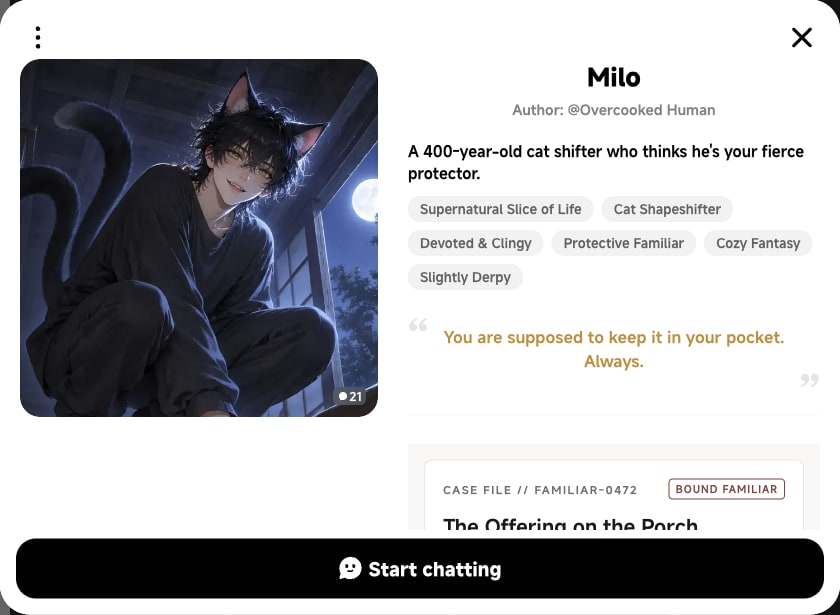
A useful character profile makes identity and relationship context visible before the first message.
3. Check How the App Helps You Discover Characters
Even an excellent character library is difficult to use without good discovery. The app should help both users who know exactly what they want and users who are open to surprise.
Useful discovery tools include:
- Categories for broad interests such as romance, fantasy, or slice of life
- Recommendations that surface different personalities
- Search for names, moods, genres, or premises
- Visual cards that communicate character identity quickly
- Profiles that are easy to preview before starting a chat
Discovery is not only navigation. It shapes the emotional experience. A thoughtful browsing flow can make meeting a character feel intentional. A weak one makes users scroll through similar faces without understanding why any of them might be a good match.
Pogee combines public character categories with recommendations, search, details, and profiles so users can move from a broad mood to a specific person.
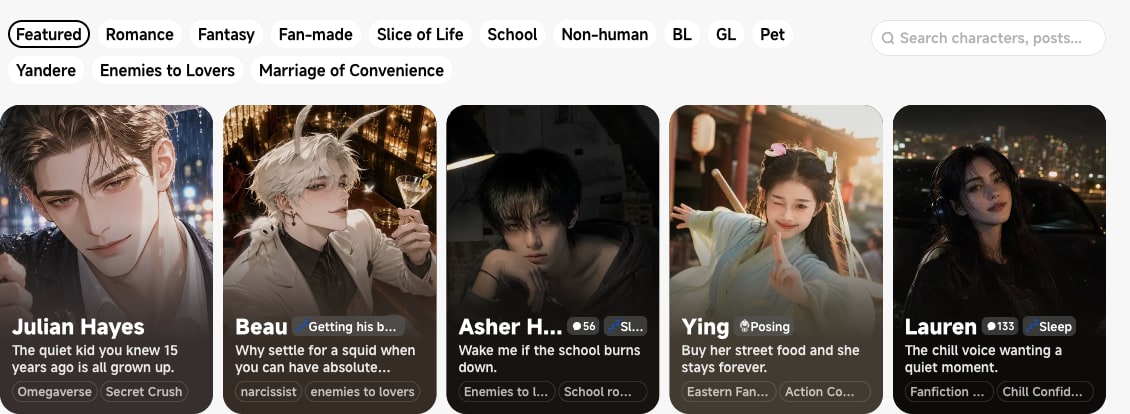
Character discovery should make different moods, genres, and relationship premises easy to compare.
4. See Whether Characters Have a Life Beyond Chat
An AI companion app can feel static when characters exist only inside individual message threads. The user has to create every topic, every scene, and every reason to return.
Profiles, posts, or daily moments can change that rhythm. They reveal what a character notices, how they spend time, and what mood surrounds them before the conversation begins. A small update can also create a natural opening for the next message.
This does not mean an app needs a constant stream of content. The moments should feel specific and connected to the character. A few coherent details are more valuable than frequent generic updates.
In Pogee, the world feed and character profiles make daily moments part of discovery. Users can notice a character through something they shared, understand the person behind it, and move into chat with context.

Daily moments create context before chat and make the character world feel active between conversations.
5. Evaluate the Whole Conversation Journey
It is easy to judge an app by one impressive reply. A better test is the complete journey around the conversation.
Ask:
- Can I understand the character before chatting?
- Does the opening feel connected to the profile and story?
- Does the character maintain a recognizable tone?
- Can I return to the character without searching from scratch?
- Is there context for what to say next?
Model quality matters, but product design also shapes the result. A strong app supports the conversation with identity, discovery, history, and clear entry points. A weak app can make even capable responses feel disconnected.
Try more than one character and more than one kind of message. A thoughtful question, a casual greeting, and a response to a profile detail can reveal whether the character is genuinely differentiated or only polished at the opening.
6. Look for Reasons to Return That Are Not Pressure
Companion apps are often designed for repeated use, but a good return experience should feel inviting rather than demanding. Users should be able to engage at their own pace.
Healthy reasons to return can include:
- Curiosity about a character's latest moment
- A conversation the user genuinely wants to continue
- New characters or worlds to discover
- A familiar profile that is easy to find again
- A story premise with room to develop
The product should also be useful in short sessions. Sometimes a user wants a long conversation; sometimes they only want to browse for a minute. An app that supports both can feel more natural and less transactional.
This is one advantage of a character world. Chat is available when the user wants it, but discovery and moments give the experience other rhythms.
7. Check Boundaries, Transparency, and Control
AI companions are virtual characters, not real people. The product should keep that distinction clear and avoid implying that it replaces human relationships, therapy, or professional support.
Before spending significant time in an app, review the product's privacy information, account controls, and terms. Consider what data you are comfortable sharing, especially in emotionally personal conversations. Users should also be able to choose the kinds of characters and scenarios they engage with.
Useful questions include:
- Is it clear that the character is AI?
- Can I review privacy and service information?
- Do I control which characters and scenarios I enter?
- Can I leave a conversation or change direction easily?
- Does the product avoid making therapeutic guarantees?
These checks are less exciting than character art or a clever opening line, but they matter for a product intended to become part of someone's routine.
Three Common Types of AI Companion App
Many products combine several styles, but it helps to recognize three broad approaches.
Chat-first companion apps focus on getting the user into a conversation quickly. They can be useful for simple, direct interaction, but may provide less context outside the thread.
Roleplay and story apps focus on scenarios, genres, and creative progression. They suit users who enjoy building scenes, but the experience depends on how well character identity survives beyond the initial premise.
Living character worlds connect chat with discovery, profiles, daily life, and multiple character paths. They suit users who want to browse, observe, and understand a character before deciding to talk.
Pogee is designed around the third approach. The aim is to make interaction feel less like requesting a roleplay on demand and more like meeting someone who already has a place in a wider virtual world.
How Pogee Fits the Comparison
Pogee brings several parts of the companion experience into one path:
- Browse daily moments and recommendations in the world feed.
- Search for characters or explore public categories.
- Open details to understand personality and story.
- View a character profile and the moments they have shared.
- Start a chat with context already in place.
This approach is especially relevant for users who value character presence and discovery. It does not depend on presenting Pogee as a generic assistant. The product is organized around individuals, their worlds, and the route from noticing someone to beginning a conversation.
Choose the App You Will Actually Want to Reopen
The best AI companion app is not necessarily the one with the longest feature list or the most dramatic promise. It is the one whose characters feel distinct, whose discovery flow respects your interests, and whose experience remains inviting after the novelty of the first message.
Compare identity, context, daily life, conversation quality, return rhythm, and boundaries. Those signals reveal more than a single demo conversation can.
Explore the living character world at Pogee, or browse romance, fantasy, and slice-of-life characters.
FAQ
What is an AI companion app?
An AI companion app lets users interact with virtual personalities through conversation. Some apps also include character profiles, stories, discovery, daily moments, or roleplay scenarios.
What is the best AI companion app?
The best choice depends on whether you want casual conversation, romance, fantasy, roleplay, storytelling, or a broader character world. Compare the full experience rather than one opening reply.
What features should an AI companion app have?
Useful features include distinct character profiles, search and recommendations, coherent conversation, visible context outside chat, easy ways to return, and clear privacy and service information.
Is Pogee an AI companion app?
Yes. Pogee is designed as a living character world where users can discover characters, browse their profiles and daily moments, and then begin conversations with more context.