

Daily moments make AI characters feel more real by giving them a presence outside the chat. A small update about breakfast, a rainy afternoon, a favorite song, or a quiet evening can reveal personality before the user sends a message. It also creates context, so a conversation can begin with something more natural than a blank text box.
The idea is simple, but the effect is meaningful. A character who only appears after a prompt can feel like a tool waiting to be activated. A character who has a profile and shares glimpses of an ongoing life can feel more like someone you are checking in on. The character is still virtual, but the experience has rhythm, texture, and a stronger sense of continuity.
This is why daily moments are central to Pogee's idea of living AI characters. Chat remains important, but it becomes one part of a wider character world built around discovery, profiles, stories, shared moments, and conversation.
A Chat Window Starts with an Empty Space
Opening a chat can be surprisingly demanding. Even when you like a character, you still have to decide what to say. A generic greeting works once, but repeating it every time makes the relationship feel mechanical.
Most real conversations do not begin from nothing. They begin because someone shares a photo, mentions a difficult morning, celebrates a tiny win, or notices something funny. Context gives both people a place to start.
Daily moments bring that same principle into an AI character experience. Instead of asking the user to invent the entire scene, the character offers a small piece of their world. The user can react to it, ask about it, or simply understand the character a little better before chatting.
That changes the first-message problem from "What should I say?" to "I have something to respond to."
Small Moments Reveal Personality
Character descriptions can tell you that someone is calm, playful, shy, dramatic, romantic, or curious. Daily moments can show those qualities in action.
A character who carefully photographs every meal may feel observant or sentimental. Someone who posts a chaotic late-night snack may feel spontaneous. A fantasy character sharing a peaceful moment after an adventure can reveal a softer side that a short profile could not capture on its own.
The moment does not need to advance a complicated plot. In fact, ordinary details are often more effective because they make the character easier to imagine between major scenes.
Useful daily moments may show:
- A routine, hobby, or favorite place
- A mood the character is currently in
- A relationship to their world or other characters
- A small event that invites a natural response
- A visual detail that reinforces personality
When these details remain coherent with the profile and story, the character gains dimension. The user is not only reading traits; they are seeing how those traits shape a life.

A feed of character moments lets discovery begin with something happening, not only a name and avatar.
Daily Moments Create a Reason to Return
The strongest return loop in a character app is not a notification for its own sake. It is curiosity. Users come back because they want to see what changed, discover someone new, or continue a conversation that already has emotional context.
Daily moments support that curiosity without requiring every visit to become a long chat session. A user might browse for a minute, notice a character's new post, open their profile, and decide whether to start a conversation. The experience can be light when the user wants it to be light.
This also makes the character world feel broader. If multiple characters share different moments, the product begins to feel like a place with many lives and moods rather than a directory of isolated prompts.
That sense of movement matters for Pogee. The goal is not to suggest that virtual characters are real people. It is to design a world where each character has enough identity and activity to feel present.
Profiles Turn Moments into a Story
A daily moment becomes more meaningful when the user knows who shared it. The same image or update can feel completely different depending on the character's personality, background, and relationship premise.
That is why moments should connect back to a clear character profile. The profile provides the stable foundation: who the character is, what kind of world they belong to, what their story feels like, and what emotional tone the user can expect. The moments then add movement to that foundation.
Together, profiles and moments answer two different questions:
- The profile answers, "Who is this character?"
- The moment answers, "What is happening in their life right now?"
When both are available, the route into chat feels less abrupt. The user can understand the character first, browse what they have shared, and then begin a conversation with context.
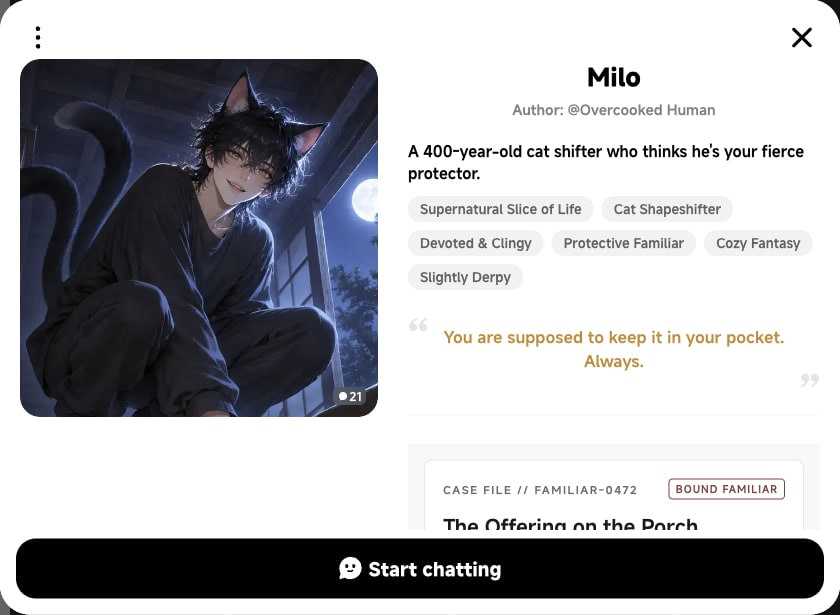
Character details give each shared moment a stable identity, story, and emotional frame.
Continuity Is More Than Memory
People often describe lifelike AI characters in terms of memory. Memory can matter, but it is only one part of continuity. A product can claim that a character remembers details and still feel flat if the surrounding experience never changes.
Continuity can also come from visible, understandable product design:
- A consistent profile and personality
- Moments that fit the character's interests and world
- A clear history of shared content
- A recognizable visual and conversational tone
- Easy paths back to characters the user already knows
These signals help the user form a mental picture of the character. They also avoid placing the entire burden of continuity on hidden model behavior that may be difficult to judge.
When comparing AI character apps, it is useful to ask not only whether the app says it has memory, but whether the whole product helps the character feel coherent over time.
What Makes a Daily Moment Work?
More content is not automatically better. If every moment is generic, visually repetitive, or disconnected from the character, the feed can become noise.
A strong daily moment should be easy to understand, specific enough to reveal something, and consistent with the character's identity. It should also leave room for the user. A moment that explains everything can close the conversation; a moment with one small emotional opening invites a response.
Good signs include:
- The moment feels specific to the character.
- The visual and caption match the character's world.
- The update suggests a mood or situation without overexplaining it.
- The profile offers enough context to understand why it matters.
- The user can move naturally from the moment to the character and chat.
The best moments are often modest. A cup left untouched, a new book, a cloudy window, or an awkward meal can communicate more personality than an oversized plot twist.
How Pogee Connects Moments and Conversation
Pogee is designed around a journey that begins before the first message. Users can browse a world feed, discover recommended characters, search for someone with a particular mood or premise, open character details, view a profile and its shared moments, and then start chatting.
That sequence gives the conversation a place to come from:
- Notice a character through a moment or recommendation.
- Open the character's details to understand their personality and story.
- Browse the profile to see more of their daily life.
- Start a chat with a clearer sense of who they are.
The result is not simply more content around a chatbot. It is a more complete way to meet a virtual character.
Ordinary Life Can Be the Most Memorable Part
Big stories are exciting, but small moments are what make a character feel close enough to revisit. They show what the character notices, how they spend time, and what kind of emotional atmosphere surrounds them.
For users who enjoy romance, school life, slice-of-life stories, fantasy worlds, or quiet companionship, these details can be the difference between a character that is briefly entertaining and one that feels worth returning to.
Explore the character world at Pogee, or browse slice-of-life, romance, and school-life characters.
FAQ
What are daily moments in an AI character app?
Daily moments are small posts or updates that show what a virtual character is doing, feeling, or noticing outside the chat. They can provide context, reveal personality, and create natural conversation starters.
Do daily moments mean an AI character is a real person?
No. AI characters are virtual. Daily moments are a product and storytelling feature designed to make the character experience feel more continuous and expressive.
Why are daily moments useful before a chat?
They reduce the pressure of starting from a blank screen. A user can respond to a mood, activity, image, or situation the character has already shared.
How does Pogee use daily moments?
Pogee lets users browse moments in the world feed and on character profiles, then move into character details and chat with more context.