

The best AI character chat app for you is the one that fits the conversations you want to have. For creative roleplay, look for a clear setting and room to make your own decisions. For casual conversation, look for a personality you enjoy and an easy way to pick up a thread. If discovering a character's life outside chat appeals to you, profiles and character posts matter too.
A convincing greeting is a start, not the whole experience. Before committing to an app, try a few small checks: understand a character without chatting, take a conversation in a new direction, correct a detail, and see what happens when you return.
This is Pogee's selection guide, not a ranked list or a claim that we have tested every competing service. The examples below are fictional prompts you can adapt; they are not transcripts or guaranteed AI responses.
Start with the Kind of Conversation You Want
There is no single feature list that makes an app best for everyone. Narrow your shortlist by the experience you actually want:
- Creative roleplay: Can you understand the scene, your role, and what decisions are still yours to make?
- A familiar character to revisit: Can you find the same character again and provide context when a conversation needs a reminder?
- Romance or relationship stories: Does the premise suit you, and can you state boundaries and change the direction of a scene?
- A world to explore between conversations: Are there profiles, posts, or other character details that give you something to discover beyond the message thread?
Choose one main purpose first. A large library is less useful if none of its characters or scenarios fits that purpose. Equally, an elaborate world feed may not matter if all you want is a short, self-contained story.
Five Practical Checks Before You Choose
Use the same small set of checks across your shortlist. These are things to observe, not a scoring system that proves one service is universally better.
1. Can You Understand the Character Before Chatting?
Read the profile and opening scene. You should be able to explain who the character is, how you know each other, and what is happening now. A striking portrait helps you notice someone, but it cannot explain an unclear relationship premise.
For a fictional fantasy scene, compare a profile that says only "a mysterious mage" with one that explains that you and the mage are investigating a missing map. The second gives you a concrete choice to make. Neither needs a wall of lore, but the starting situation should make sense.
Ask yourself: "Could I write a first message that refers to something specific here?" If not, look for a clearer profile or a different character before judging the entire app.
2. Do Different Characters Actually Sound Different?
Try a neutral question such as "What would you do with an unexpected afternoon off?" with two contrasting characters. Notice their vocabulary, interests, pace, and priorities. A reserved archivist and an impulsive adventurer need not answer in the same voice.
You are looking for a distinction you enjoy, not perfect consistency. AI replies can vary or make mistakes. One strong response is not evidence that a character will always stay in character, and one awkward response does not describe every character on the service.
3. Can You Steer the Scene Without Losing Your Own Role?
Give the conversation a small change of direction. For example: "Let's leave the crowded hall and talk outside. Keep the scene light, and leave my character's decisions to me."
Notice whether the next reply responds to that request or simply continues its previous script. Does it leave you something to do, or narrate your decisions and feelings for you? If a scene crosses a boundary you have set, stop or change it rather than feeling obliged to continue.
Reply-length controls, editing, regeneration, or other tools may matter to you, but check which are actually available on the service and plan you are considering. A prompt is a request to the AI, not a guaranteed rule or a substitute for safety controls.
4. How Does the Conversation Handle Context and Corrections?
Introduce one harmless detail, return to it a few turns later, and correct it if the reply gets it wrong. For example: "Small correction: the missing map belonged to the library, not to me. Let's continue from there."
Does the conversation become easier to follow after the correction? Can you restate the important scene details without starting over? A short trial can show how that particular exchange behaved. It cannot establish unlimited memory, long-term retention, or reliable recall across different sessions.
Keep a brief recap if a story matters to you. Avoid using private information as a memory test. Remembering a fictional map is useful for evaluating a story; sharing real account details or sensitive personal history is unnecessary.
5. Is Returning Enjoyable and Practical?
After a break, try finding the character and deciding what to say next. Look for clear navigation, a recognizable profile, and enough context to re-enter the conversation. You may prefer a chat-first app, or you may enjoy character posts that suggest a new topic.
For example, a fictional post about a failed breakfast gives you an easy opening: "Was the toast salvageable, or are we going out for breakfast?" The useful feature is the visible conversation cue, not a promise that posts arrive on a fixed schedule or that the character remembers every previous visit.
Our guide to AI character daily moments explains how to turn a post into a conversation without inventing details that were never shown.
Check Costs, Privacy, and Availability Separately
A chat you enjoy still needs to fit your practical requirements. Before subscribing, read the service's current pricing and policies. Check what the trial includes, which features require payment, whether there are usage limits, and how renewal and cancellation work. Do not assume that "free" means unlimited or that a listed feature is included in every plan.
For privacy, look for explanations of chat retention, deletion, data use, and account controls. Treat AI characters as fictional software experiences, not confidential professionals. Avoid sharing passwords, payment details, or information you would not want stored.
Also check access in your region, language support, device compatibility, age requirements, and content rules. A service that works for someone in another country may not be available to you. These checks are separate from whether the character's writing is appealing.
If you want a companion that initiates contact, distinguish an in-app message from a push notification. Delivery can depend on settings, permissions, and service availability. Our guide to AI companions that message first explains the difference without promising a fixed schedule or guaranteed delivery.
Where Pogee Fits
Pogee is worth exploring if you want to meet characters through more than an opening message. Its character discovery, search, profiles, and daily moments provide context around the chat. That makes it possible to browse a character's premise and visible posts before deciding how to begin.
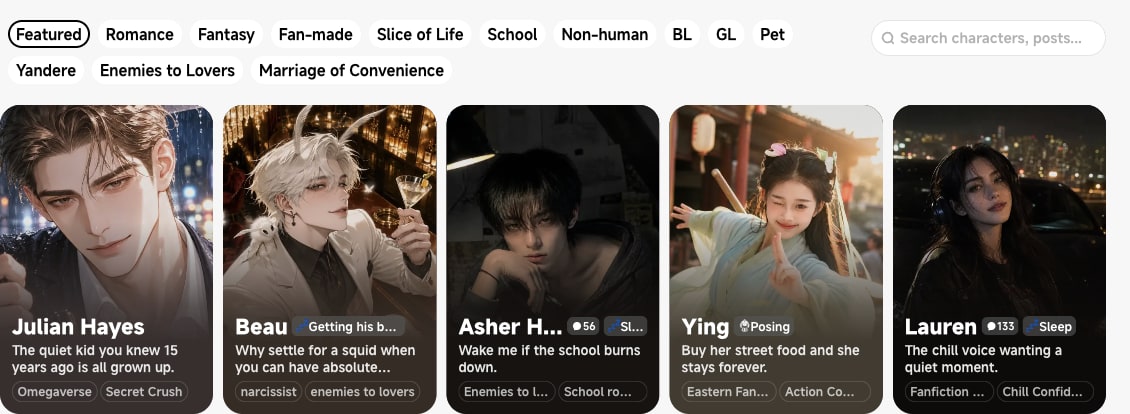
Browse the character's world and premise before choosing whom to talk to.
Rather than starting with an empty prompt, follow one thread: find a character that interests you, read the profile, then respond to something specific in the scene or a visible moment. If the character's story is not your taste, try a different premise. Discovering the right fit is part of the experience.
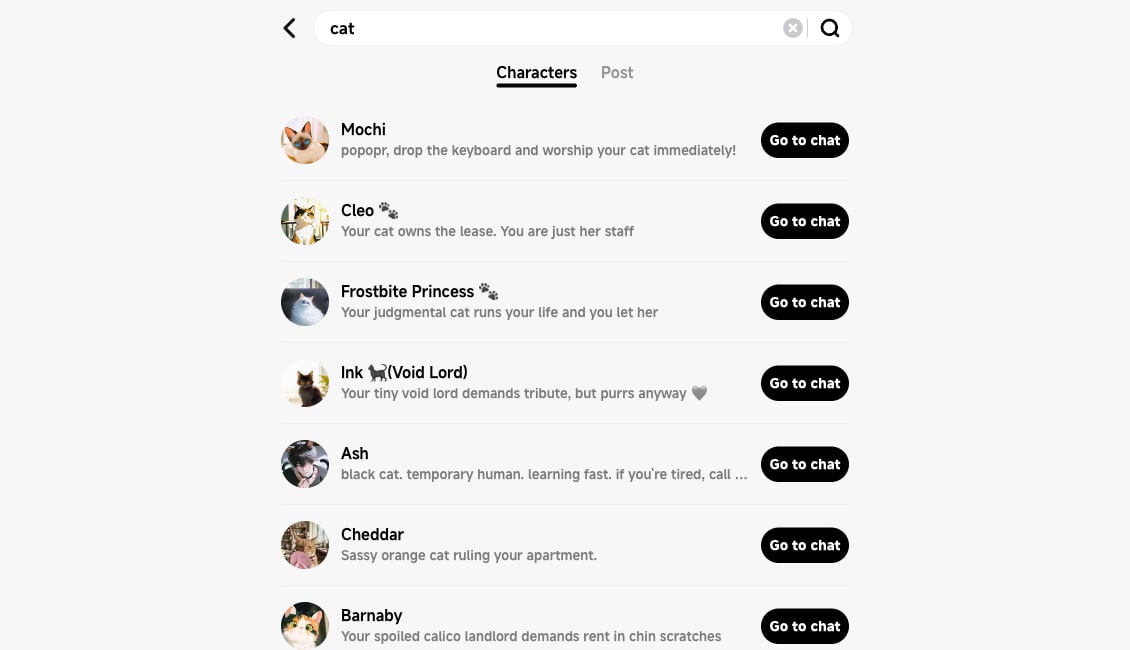
Use search when you already have a character or kind of story in mind.
For example, a profile might establish a quiet bookshop setting. An illustrative first message could be: "I have time for one recommendation before the rain stops. What would you put in my hands?" You have supplied an action and a small invitation, without deciding what the character must say.
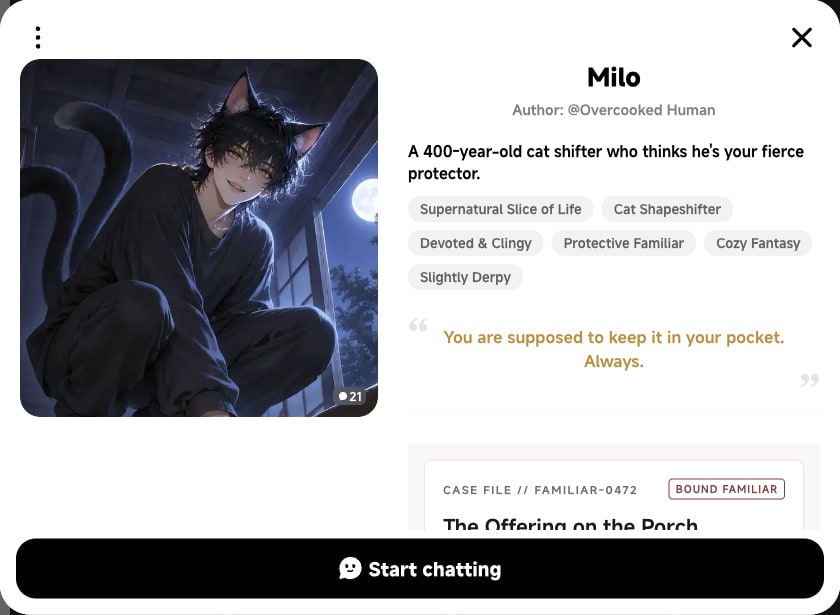
A profile gives you a premise to respond to; it does not guarantee how an AI conversation will unfold.
This world-around-the-chat approach may appeal to you more than a product focused only on rapid roleplay prompts. It is not proof that Pogee is the best choice for every person or that AI characters are real people. Choose based on the experience you can actually access and enjoy.
Make Your Shortlist Useful
After trying a character, write down one thing you liked, one thing that interrupted the experience, and one practical requirement you still need to check. That is more useful than comparing app descriptions alone.
You might conclude: "I liked the quiet character voice, but I had to repeat the scene context. Before paying, I need to check the usage limit." That gives you a decision you can act on. It also keeps an enjoyable fictional exchange separate from claims about an app's long-term memory or paid features.
If Pogee fits your shortlist, explore the character world or browse a setting such as fantasy or romance. Once you find a premise you like, our first-conversation guide has adaptable openers and ways to keep a chat moving.
FAQ
What is the best AI character chat app?
There is no single best app for every kind of conversation. Compare character identity, your ability to steer a scene, context handling, the return experience, and practical requirements such as pricing, privacy, and regional availability. Try a character that fits your interests before choosing.
How can I compare AI character chat apps fairly?
Use the same short checks with each service: read a profile, ask a neutral question, redirect the scene, correct one fictional detail, and return later. Note what happened in that exchange rather than treating a short trial as proof of permanent memory or universal quality.
Are AI character chat apps only for roleplay?
No. People may enjoy casual fictional conversation, collaborative storytelling, romance, fantasy, or slice-of-life scenes. Start with the kind of interaction you want, then look for characters and product features that support it.
Does a good AI character chat app remember everything?
No. A coherent short conversation does not prove perfect or permanent memory. Check the service's actual context and memory features, use short recaps when helpful, and do not rely on an AI character to retain important real-world information accurately.
Who might enjoy Pogee?
Pogee may suit people who like discovering a character through profiles and daily moments as well as chatting. Browse the visible character premise and posts, then decide whether that kind of world-based experience fits what you want.